
-
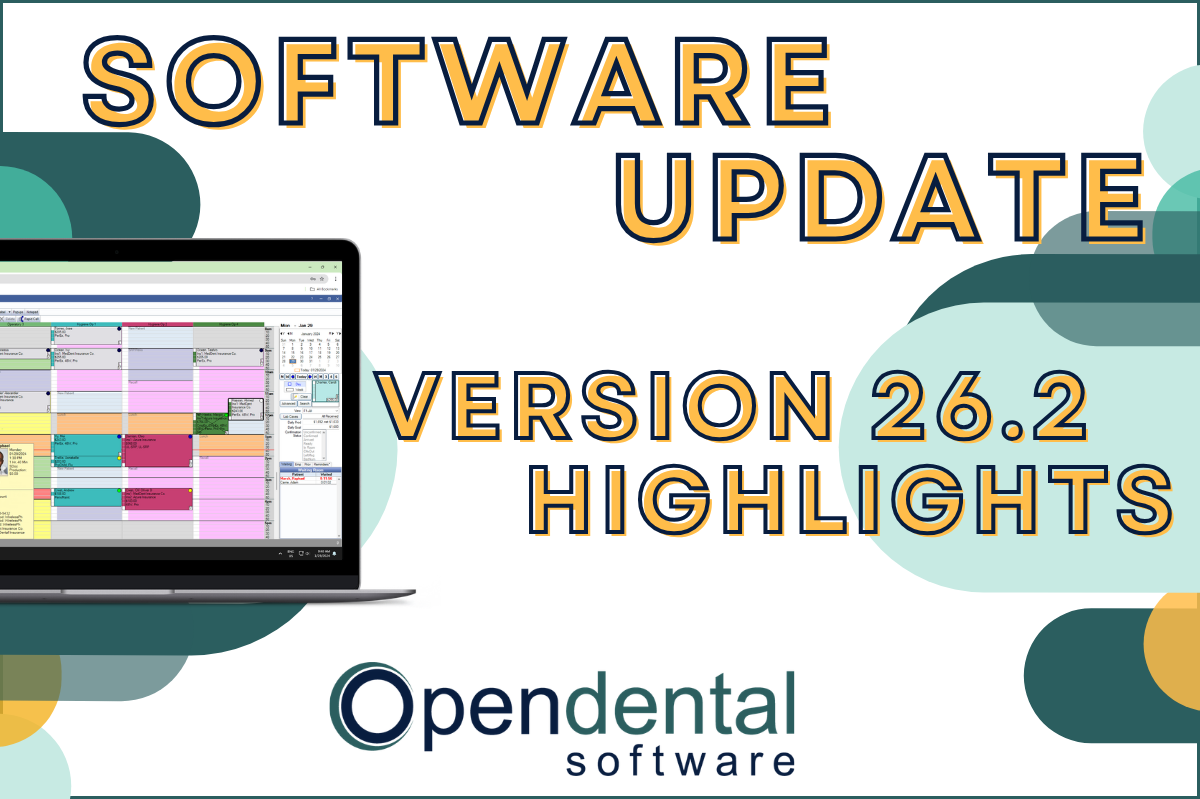 Read more: Software Update: Stable Version 26.2 Highlights
Software Update: Stable Version 26.2 Highlights
Open Dental 26.2 is live! Updates include advanced blockout searching, new perio chart shortcuts, automated MariaDB backups, and more!
-

Sharing Open Dental Info: Importing and Exporting
Read more: Sharing Open Dental Info: Importing and ExportingThis post will discuss the various ways you can share Open Dental information you’ve customized using the Import & Export tools within the program.
-

Best Practices for Allocating Patient Payments
Read more: Best Practices for Allocating Patient PaymentsLearn how to allocate patient payments to the correct family members, procedures, or adjustments, so patient balances & reports are accurate.
-

FAQs Answered: Treatment Plan Module
Read more: FAQs Answered: Treatment Plan ModuleThis post answers common questions on the Treatment Plan module in Open Dental. Learn how to troubleshoot common questions that come up when using the Treatment Plan Module.
-

Taking on the Treatment Plan
Read more: Taking on the Treatment PlanThe Treatment Plan is vital for presenting your patients with recommended treatment, determining insurance estimates, and estimated patient responsibility. In this post, we’ll cover preauthorizations, saving and signing treatment plans, and more!
Guest Posts
Read content written by featured third-party guest writers.
-
 Read more: 3 Key Strategies to Help Move More Dental Care Forward
3 Key Strategies to Help Move More Dental Care Forward
The CareCredit Dental Path to Purchase study highlights the importance of transparent financing discussions, showing that many patients delay care due to cost concerns and inadequate payment information.
-
 Read more: Best Practices for Featuring Financing in Dental Treatment Plans
Best Practices for Featuring Financing in Dental Treatment Plans
Many patients skip recommended dental care because of cost, not because they don’t want it. Offering flexible financing and training your team to talk about it clearly can make a real difference in treatment acceptance and patient trust.
-
 Read more: How to Understand Dental Marketing ROI
How to Understand Dental Marketing ROI
Dental marketing ROI isn’t just about how much you spent vs. how much you made. Leads, scheduling rates, treatment acceptance, and lifetime patient value all play a role. Here’s how to connect the dots.
-
 Read more: Standardizing Workflows Across Multi-Location Open Dental Practices
Standardizing Workflows Across Multi-Location Open Dental Practices
In multi-location dental practices, small inconsistencies in communication and scheduling add up fast. Here’s how DSOs can build standardized workflows that improve patient experience, reduce admin burden, and scale without friction.
-
 Read more: How Often Should Healthcare Providers Test Backup Restore?
How Often Should Healthcare Providers Test Backup Restore?
Healthcare providers are advised to conduct monthly backup restore tests, with quarterly full-system validations and annual disaster simulations recommended for high-risk organizations. Backup monitoring alone does not ensure recoverability; restore testing is essential to confirm that clinical systems and patient data can be operationally restored within acceptable downtime.
-
 Read more: Understanding EPCS Certification
Understanding EPCS Certification
EPCS certification isn’t just a regulatory checkbox. It’s what makes electronic prescribing of controlled substances actually safe, reducing fraud, cutting errors, and keeping providers on the right side of DEA requirements.