
-
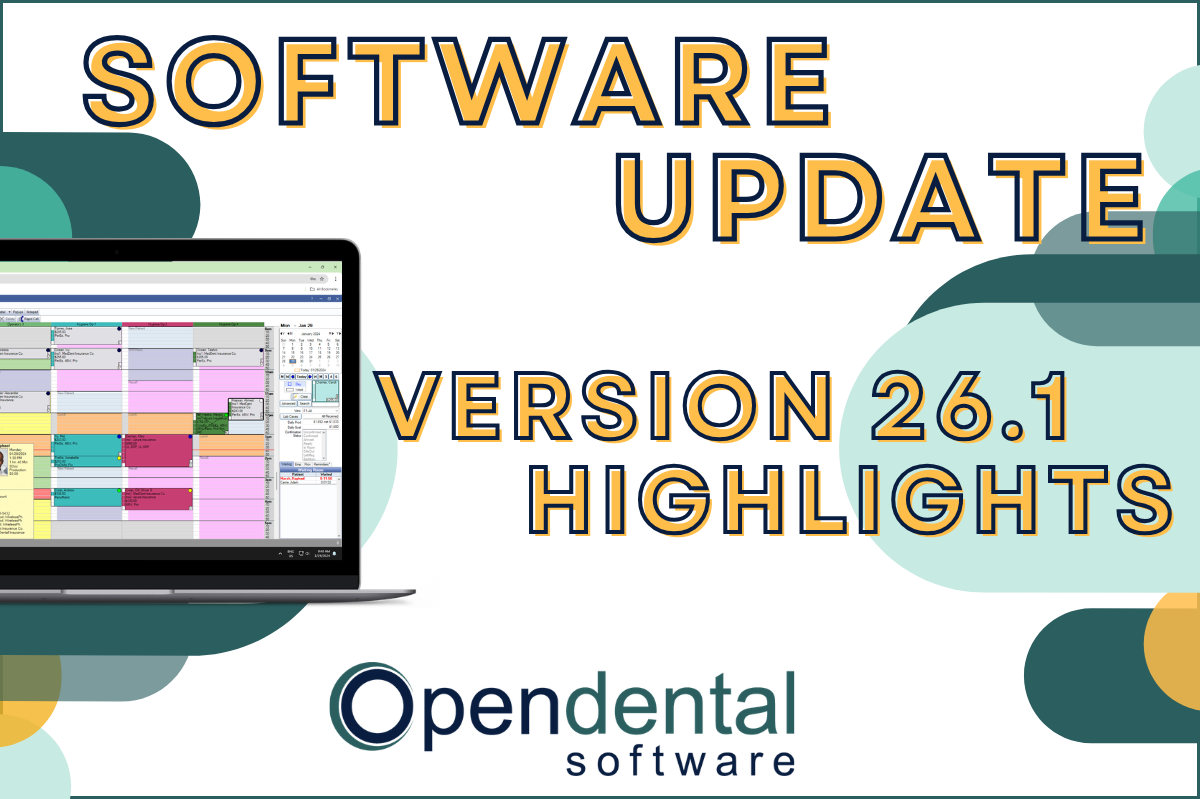 Read more: Software Update: Stable Version 26.1 Highlights
Software Update: Stable Version 26.1 Highlights
Open Dental 26.1 is now stable! New features include ODTouch 25, custom insurance history categories, HTML billing emails, and much more.
-

Patient Statements, Explained: Monthly Billing
Read more: Patient Statements, Explained: Monthly BillingLearn how to use the tools to create patient statements in Open Dental to ensure patients are billed in a timely manner and for the amounts they owe, without anyone slipping through the cracks.
-

Revolutionize Your Workflow with Customized Appointment Views
Read more: Revolutionize Your Workflow with Customized Appointment ViewsCustomizing appointment views in Open Dental enhances efficiency by displaying relevant operatories and information quickly.
-

Software Update: Stable Version 25.1 Highlights
Read more: Software Update: Stable Version 25.1 HighlightsOpen Dental Version 25.1 has been released as Stable! Our latest blog post goes into some of the highlights from this version, including a few user feature requests!
-

A Newbie’s Guide to Open Dental
Read more: A Newbie’s Guide to Open DentalNew to Open Dental? There’s a lot to learn, but not to worry, we’re here to help! In this post, we review the basics and provide some resources for learning and support.
Guest Posts
Read content written by featured third-party guest writers.
-
 Read more: How DentalXChange’s Eligibility AI Is Getting Smarter
How DentalXChange’s Eligibility AI Is Getting Smarter
Manual eligibility checks are slow and error-prone. DentalXChange’s Eligibility AI now writes verified benefit data directly into your system, no retyping required.
-
 Read more: Best Practices for Featuring Financing in Dental Treatment Plans
Best Practices for Featuring Financing in Dental Treatment Plans
Many patients skip recommended dental care because of cost, not because they don’t want it. Offering flexible financing and training your team to talk about it clearly can make a real difference in treatment acceptance and patient trust.
-
 Read more: How to Understand Dental Marketing ROI
How to Understand Dental Marketing ROI
Dental marketing ROI isn’t just about how much you spent vs. how much you made. Leads, scheduling rates, treatment acceptance, and lifetime patient value all play a role. Here’s how to connect the dots.
-
 Read more: Standardizing Workflows Across Multi-Location Open Dental Practices
Standardizing Workflows Across Multi-Location Open Dental Practices
In multi-location dental practices, small inconsistencies in communication and scheduling add up fast. Here’s how DSOs can build standardized workflows that improve patient experience, reduce admin burden, and scale without friction.
-
 Read more: How Often Should Healthcare Providers Test Backup Restore?
How Often Should Healthcare Providers Test Backup Restore?
Healthcare providers are advised to conduct monthly backup restore tests, with quarterly full-system validations and annual disaster simulations recommended for high-risk organizations. Backup monitoring alone does not ensure recoverability; restore testing is essential to confirm that clinical systems and patient data can be operationally restored within acceptable downtime.
-
 Read more: Understanding EPCS Certification
Understanding EPCS Certification
EPCS certification isn’t just a regulatory checkbox. It’s what makes electronic prescribing of controlled substances actually safe, reducing fraud, cutting errors, and keeping providers on the right side of DEA requirements.