
-
 Read more: Software Update: Stable Version 25.4 Highlights
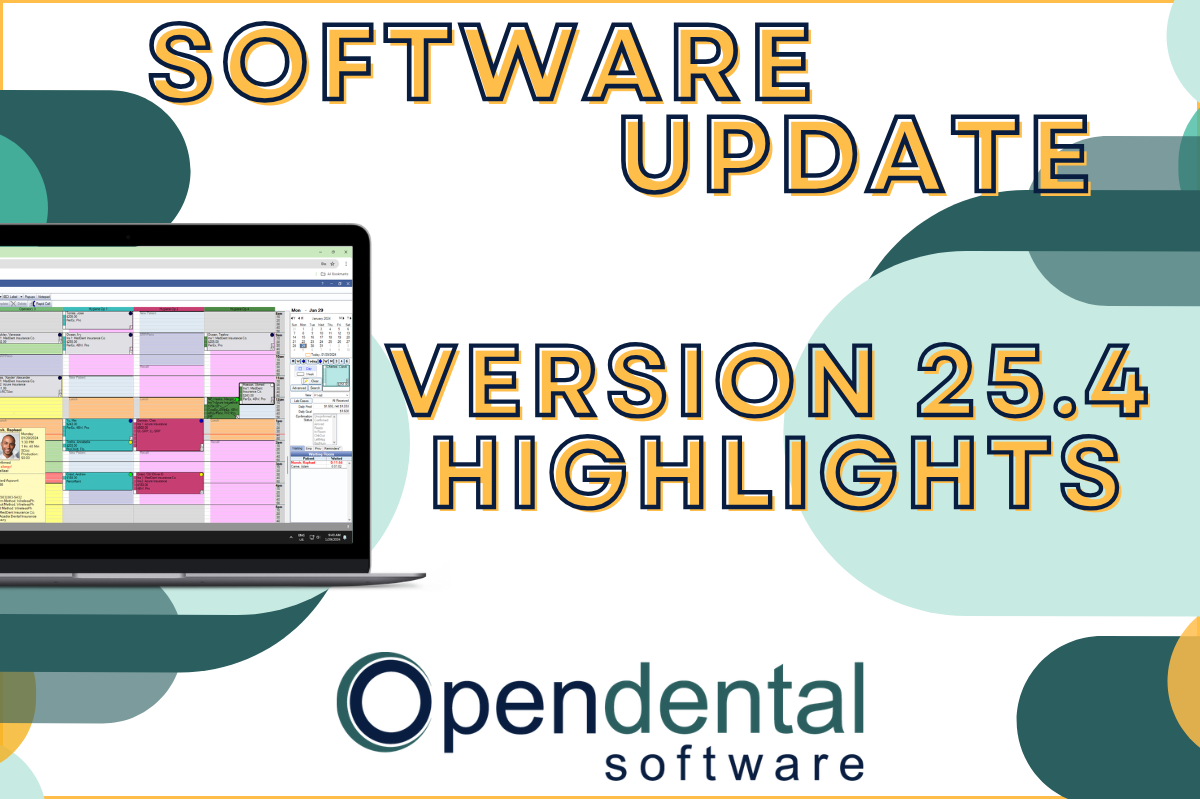
Software Update: Stable Version 25.4 Highlights
Open Dental 25.4 is live and packed with updates. From OCR on eClipboard that auto-fills patient insurance info, to a Clerri integration for in-house membership plans, there’s a lot to explore, including 11 features requested directly by users.
-

Teledentistry and Open Dental
Read more: Teledentistry and Open DentalTeledentistry may not have been part of your patient care before, but it is now an important part of offering diagnostic and follow-up care to your patients. This post provides resources and the setup steps needed in Open Dental to accommodate teledentistry.
-

Staying Productive and Proactive When You’re Not Seeing Patients
Read more: Staying Productive and Proactive When You’re Not Seeing PatientsTake these steps to be productive and proactive when you’re not seeing patients so that when business picks up again, you’ll be poised and ready with increased efficiency and productivity.
-

Funding Unscheduled Treatment with Tax Refunds
Read more: Funding Unscheduled Treatment with Tax RefundsConsumer health spending jumps after patients receive their tax refunds, so now is the time to contact patients with Unscheduled Treatment, and we have the 4 simple steps that will help you get it done today.
-

Software Update: Stable Version 19.3 Highlights
Read more: Software Update: Stable Version 19.3 HighlightsSOFTWARE UPDATE: Version 19.3 has been released as Stable, implementing 15 features requested by our users. Watch the video and read all the version highlights here.
Guest Posts
Read content written by featured third-party guest writers.
-
 Read more: Understanding EPCS Certification
Understanding EPCS Certification
EPCS certification isn’t just a regulatory checkbox. It’s what makes electronic prescribing of controlled substances actually safe, reducing fraud, cutting errors, and keeping providers on the right side of DEA requirements.
-
 Read more: How to Understand Dental Marketing ROI
How to Understand Dental Marketing ROI
Dental marketing ROI isn’t just about how much you spent vs. how much you made. Leads, scheduling rates, treatment acceptance, and lifetime patient value all play a role. Here’s how to connect the dots.
-
 Read more: Standardizing Workflows Across Multi-Location Open Dental Practices
Standardizing Workflows Across Multi-Location Open Dental Practices
In multi-location dental practices, small inconsistencies in communication and scheduling add up fast. Here’s how DSOs can build standardized workflows that improve patient experience, reduce admin burden, and scale without friction.
-
 Read more: How Often Should Healthcare Providers Test Backup Restore?
How Often Should Healthcare Providers Test Backup Restore?
Healthcare providers are advised to conduct monthly backup restore tests, with quarterly full-system validations and annual disaster simulations recommended for high-risk organizations. Backup monitoring alone does not ensure recoverability; restore testing is essential to confirm that clinical systems and patient data can be operationally restored within acceptable downtime.
-
 Read more: AI Dental Software: What Actually Works in Modern Dental Practices
AI Dental Software: What Actually Works in Modern Dental Practices
Staff shortages, endless charting, patients who zone out mid-explanation. These are real problems. AI dental software is quietly solving them. Here’s what it does, what it doesn’t, and how to know if it’s right for your practice.
-
 Read more: Beyond the Basics: How Seamless Integration is Changing the Game for Open Dental Practices
Beyond the Basics: How Seamless Integration is Changing the Game for Open Dental Practices
In this post from our guest writer Verifixed learn how integrations can help improve your practice’s workflow and productivity.