
-
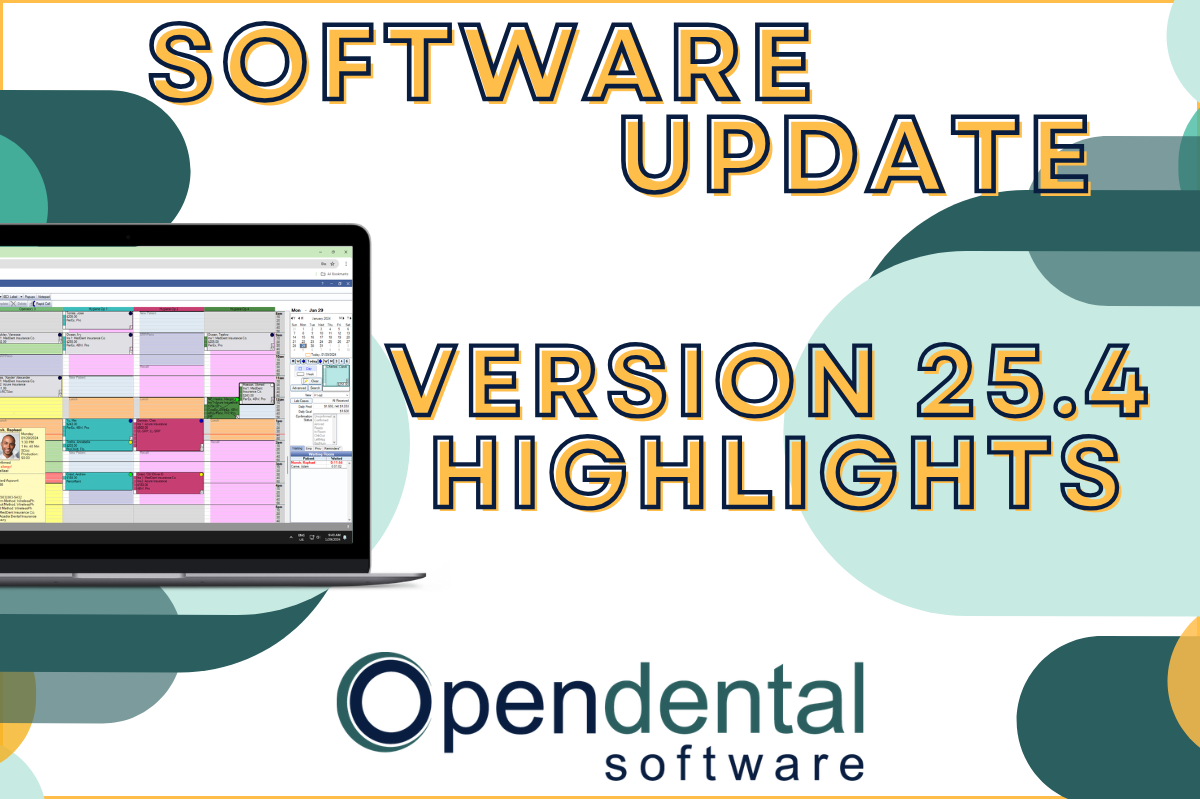 Read more: Software Update: Stable Version 25.4 Highlights
Software Update: Stable Version 25.4 Highlights
Open Dental 25.4 is live and packed with updates. From OCR on eClipboard that auto-fills patient insurance info, to a Clerri integration for in-house membership plans, there’s a lot to explore, including 11 features requested directly by users.
-

Updating Open Dental
Read more: Updating Open DentalDental practices on support with Open Dental receive several free software updates each year with new features and enhancements.
-

Fun (and Function) with Colors
Read more: Fun (and Function) with ColorsCustomizing colors can provide more than fun and flair – it can help improve function by allowing easy identification of different types of information. Learn more about where and how you can customize colors in Open Dental.
-

Get to Know the “Patients-Raw” Report
Read more: Get to Know the “Patients-Raw” ReportSometimes you want to pull a quick set of patient data out of Open Dental. See how the Patients-Raw report may be just what you need.
-

Meet ODTouch
Read more: Meet ODTouchMeet Open Dental’s new eService app, ODTouch. Use the app as your clinical tool to complete tasks, like charting, scheduling, treatment planning, and more, from the convenience of a tablet.
Guest Posts
Read content written by featured third-party guest writers.
-
 Read more: Understanding EPCS Certification
Understanding EPCS Certification
EPCS certification isn’t just a regulatory checkbox. It’s what makes electronic prescribing of controlled substances actually safe, reducing fraud, cutting errors, and keeping providers on the right side of DEA requirements.
-
 Read more: A Comprehensive Guide to Data Backup: A-Z Backup Info
A Comprehensive Guide to Data Backup: A-Z Backup Info
Discover a comprehensive guide to data backup, covering everything from types of backups and best practices to setting up a secure backup system. Stay informed with essential backup info to protect your data effectively.
-
 Read more: Automating Dental Electronic Remittance Advice (ERA) to Modernize Dental Operations
Automating Dental Electronic Remittance Advice (ERA) to Modernize Dental Operations
Electronic Remittance Advice (ERA) is pivotal in the healthcare reimbursement process, providing detailed information about claims adjudication and payment from insurance companies.
-
 Read more: What is Clinical Decision Support and Why Should Every Clinician Use It?
What is Clinical Decision Support and Why Should Every Clinician Use It?
Learn the role clinical decision support (CDS) tools can play in delivering the best possible care to your patients.
-
 Read more: Leveraging Dental Clearinghouses: The Power of Partnership for Dental Service Organizations (DSOs)
Leveraging Dental Clearinghouses: The Power of Partnership for Dental Service Organizations (DSOs)
Learn how the collaboration of DSOs and clearinghouses drives efficiency, profitability, and sustainable growth, for enhanced patient care.
-
 Read more: Do Small Dental Practices and Start-Ups Need to Worry About Cybercrime?
Do Small Dental Practices and Start-Ups Need to Worry About Cybercrime?
As a small dental practice owner or as a dental practice start-up, you might think that cyber criminals and HIPAA violations are concerns reserved for larger healthcare organizations. The reality is that small practices and new startups are often prime targets for cyberattacks