
-
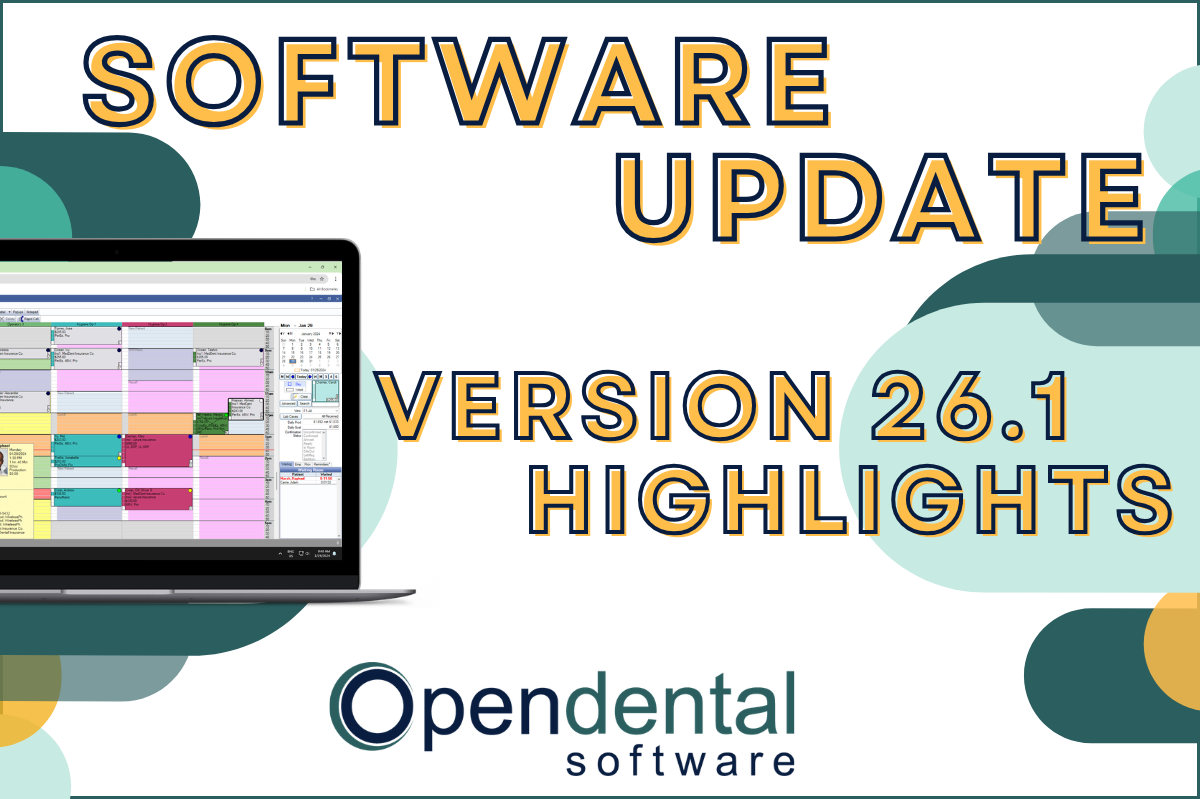 Read more: Software Update: Stable Version 26.1 Highlights
Software Update: Stable Version 26.1 Highlights
Open Dental 26.1 is now stable! New features include ODTouch 25, custom insurance history categories, HTML billing emails, and much more.
-

Software Update: Stable Version 22.2 Highlights
Read more: Software Update: Stable Version 22.2 HighlightsSoftware Update: Version 22.2 has been released as Stable with many new features including several exciting Ortho Charting additions! Learn more about them here.
-

Questions & Answers with an Open Dental Expert: Accounting Clerk
Read more: Questions & Answers with an Open Dental Expert: Accounting ClerkOpen Dental is backed by a team of experts from all walks of life. In this post we interview Jenny, a member of our Accounting Team.
-

Feature Highlight: Open Dental Apps
Read more: Feature Highlight: Open Dental AppsOpen Dental eServices offers two apps to install on your mobile device or tablet. These help you stay connected with your patients and help your practice cut down on data entry time.
-

Choosing the Best Setup for Your Multi-Location Practice
Read more: Choosing the Best Setup for Your Multi-Location PracticeThere are several ways to set up Open Dental for your multi-location practice. In this post, we’ll explore the different options and what makes a setup the right fit for your practice.
Guest Posts
Read content written by featured third-party guest writers.
-
 Read more: How DentalXChange’s Eligibility AI Is Getting Smarter
How DentalXChange’s Eligibility AI Is Getting Smarter
Manual eligibility checks are slow and error-prone. DentalXChange’s Eligibility AI now writes verified benefit data directly into your system, no retyping required.
-
 Read more: Enhancing Patient Safety with EPCS: A High-Level Overview
Enhancing Patient Safety with EPCS: A High-Level Overview
EPCS is a technological advancement that significantly improves patient safety and the efficiency of the prescribing process. Here’s a look at how EPCS achieves this through robust identity checks, accurate transmission of prescriptions, and timely delivery to pharmacies.
-
 Read more: How to Boost Patient Retention in Your Dental Practice: Tips and Strategies
How to Boost Patient Retention in Your Dental Practice: Tips and Strategies
Patient retention is vital for the long-term success of any dental practice. Read this post from DentalXChange to learn some effective tips and strategies to boost patient retention.
-
 Read more: Don’t Let Cyberattacks Disrupt Patient Care: Dental Practice Cyberattacks on the Rise
Don’t Let Cyberattacks Disrupt Patient Care: Dental Practice Cyberattacks on the Rise
Cybersecurity in dental practices is increasingly important as healthcare organizations report a spike in cyberattacks. A recent survey revealed that 92% of healthcare organizations faced a cyberattack in the past year, highlighting an urgent need for stronger defenses. While healthcare organizations averaged 40 attacks annually, about 69% of these attacks disrupted patient care These alarming…
-
 Read more: Disaster Recovery vs. Data Backup: Which Do You Need?
Disaster Recovery vs. Data Backup: Which Do You Need?
Protecting your data has never been more critical. Data loss of any kind can be devastating. The big debate when it comes to protecting this data is disaster recovery vs. backup. Read our latest blog post from our friends at Central Data Storage for an overview of data backup and recovery and and how to…
-
 Read more: AI Won’t Replace Dental Hygienists, Here’s Why
AI Won’t Replace Dental Hygienists, Here’s Why
Dental hygienists and dentists bring nuanced expertise and personal interaction that machines cannot replicate. This article explores why dental professionals are irreplaceable and what features to look for in dental AI programs.