
-
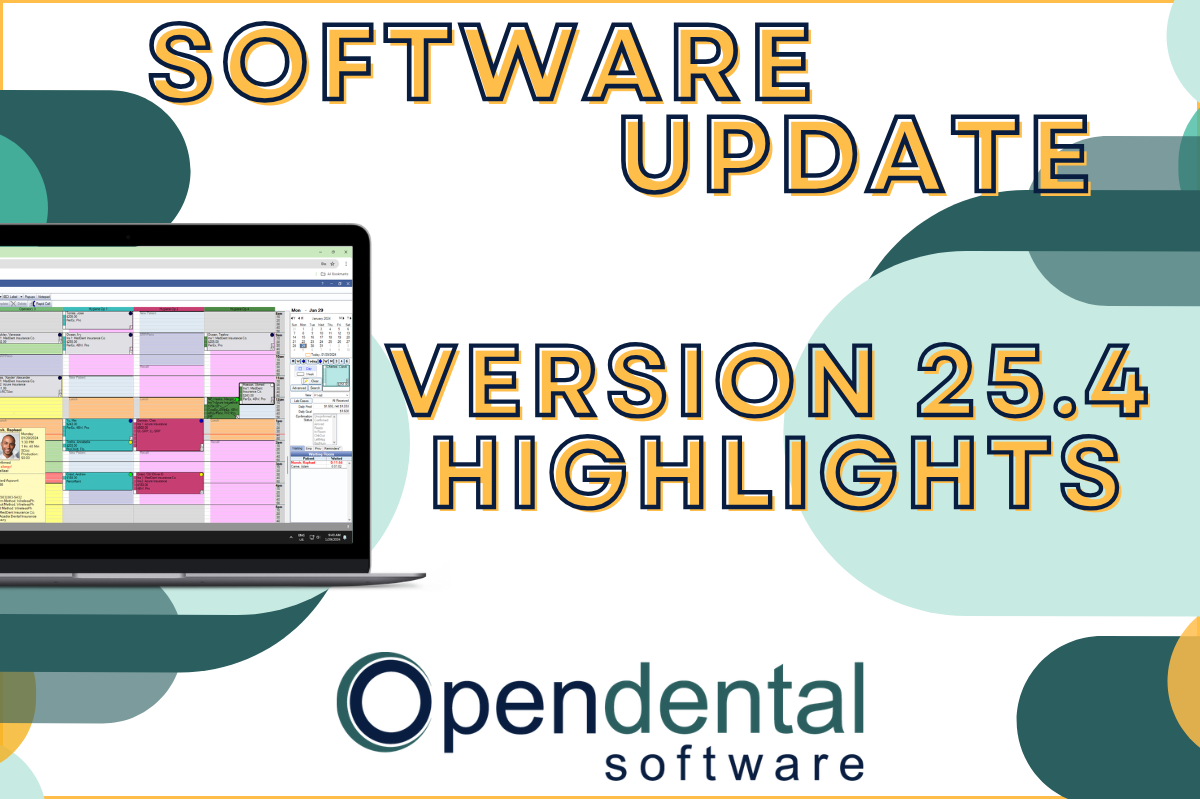 Read more: Software Update: Stable Version 25.4 Highlights
Software Update: Stable Version 25.4 Highlights
Open Dental 25.4 is live and packed with updates. From OCR on eClipboard that auto-fills patient insurance info, to a Clerri integration for in-house membership plans, there’s a lot to explore, including 11 features requested directly by users.
-

Software Update: Stable Version 22.1 Highlights
Read more: Software Update: Stable Version 22.1 HighlightsSoftware Update: Version 22.1 has been released as Stable with many new features including 15 requested by our users. Learn all about them here.
-

Common Questions Our Support Team Answers
Read more: Common Questions Our Support Team AnswersThe Open Dental Support Team has been growing and expanding our knowledge for years. Learn the answers to some of our most common questions.
-

Open Dental Features for Your More Difficult Patients
Read more: Open Dental Features for Your More Difficult PatientsYou have a variety of patients in your practice. In this post we’ll discuss features that will allow you to better manage your more difficult patients, and help them arrive for appointments and pay their bills on time.
-

Tips & Tricks #33
Read more: Tips & Tricks #33In this Tips & Tricks post, learn how to choose the right insurance plan type, see subscribers on an insurance plan, display a retained root, and work in multiple windows simultaneously.
Guest Posts
Read content written by featured third-party guest writers.
-
 Read more: Why Your Open Dental Practice Deserves a Better Membership Experience
Why Your Open Dental Practice Deserves a Better Membership Experience
Managing membership plans across disconnected systems slows your team down. Here’s how Clerri, a native Open Dental integration, changes the experience for staff and patients.
-
 Read more: A Comprehensive Guide to Data Backup: A-Z Backup Info
A Comprehensive Guide to Data Backup: A-Z Backup Info
Discover a comprehensive guide to data backup, covering everything from types of backups and best practices to setting up a secure backup system. Stay informed with essential backup info to protect your data effectively.
-
 Read more: Automating Dental Electronic Remittance Advice (ERA) to Modernize Dental Operations
Automating Dental Electronic Remittance Advice (ERA) to Modernize Dental Operations
Electronic Remittance Advice (ERA) is pivotal in the healthcare reimbursement process, providing detailed information about claims adjudication and payment from insurance companies.
-
 Read more: What is Clinical Decision Support and Why Should Every Clinician Use It?
What is Clinical Decision Support and Why Should Every Clinician Use It?
Learn the role clinical decision support (CDS) tools can play in delivering the best possible care to your patients.
-
 Read more: Leveraging Dental Clearinghouses: The Power of Partnership for Dental Service Organizations (DSOs)
Leveraging Dental Clearinghouses: The Power of Partnership for Dental Service Organizations (DSOs)
Learn how the collaboration of DSOs and clearinghouses drives efficiency, profitability, and sustainable growth, for enhanced patient care.
-
 Read more: Do Small Dental Practices and Start-Ups Need to Worry About Cybercrime?
Do Small Dental Practices and Start-Ups Need to Worry About Cybercrime?
As a small dental practice owner or as a dental practice start-up, you might think that cyber criminals and HIPAA violations are concerns reserved for larger healthcare organizations. The reality is that small practices and new startups are often prime targets for cyberattacks